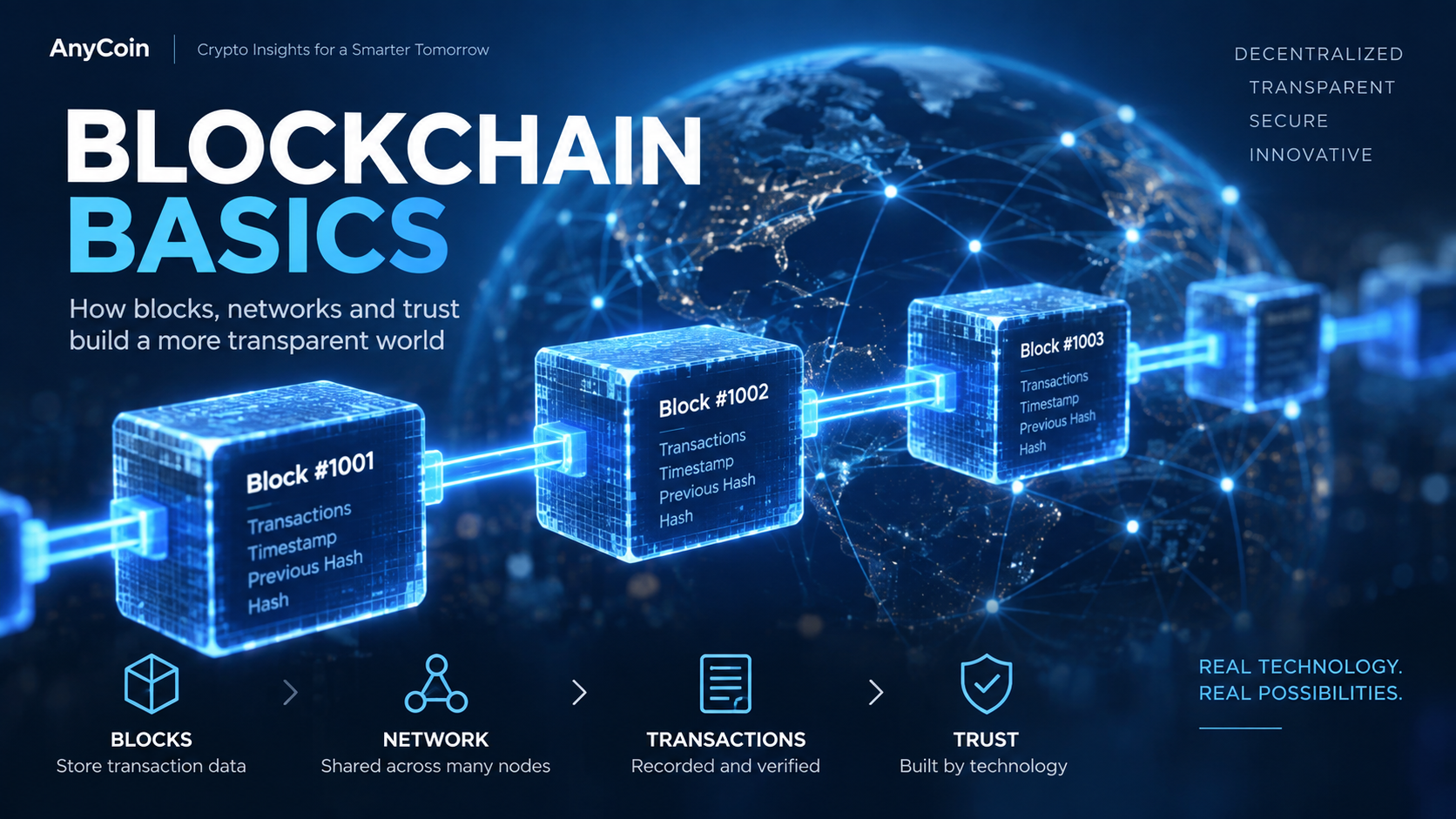
Blockchain basics start with a shared record that network participants can check and update under agreed rules. This beginner’s guide explains how blocks, consensus, and cryptographic links work together, where blockchain can be useful, and when a traditional database may be a better fit.
What Are Blockchain Basics?
A blockchain is a shared ledger that records transactions in an ordered sequence of blocks. Network participants use agreed rules to add new records, and cryptographic links help reveal attempts to change earlier ones. How transparent, secure, or resistant to tampering the ledger is depends on the network’s design and who can participate.
How Blockchain Basics Work
At its core, a blockchain relies on blocks or transaction records, network nodes, cryptography, and a consensus mechanism to maintain a shared ledger.
- Blocks or Records: Store transaction data and other information in a structured and verifiable format.
- Nodes: Computers participating in the blockchain network that store, share, and validate network data.
- Consensus Mechanisms: Rules that allow network participants to agree on valid transactions and the state of the ledger. Examples include Proof of Work (PoW) and Proof of Stake (PoS).
Depending on its design, a blockchain can allow participants to maintain and verify a shared record without relying on a single central authority.
Types of Blockchain
There are several types of blockchain networks:
- Public Blockchain: Open networks where anyone can generally participate in viewing or validating transactions, depending on the network’s rules. Bitcoin and Ethereum are well-known examples.
- Private Blockchain: Permissioned networks where participation and access are controlled by a specific organization or administrator.
- Consortium Blockchain: Permissioned networks governed by a group of organizations rather than a single entity.
Each type offers different levels of transparency, security, and efficiency depending on the use case.
Blockchain vs. Traditional Databases
Traditional databases are usually controlled by a central administrator who can create, update, or delete records. Blockchain uses a distributed ledger in which records are shared across multiple network participants and validated according to predefined rules.
Blockchain is not automatically better than a traditional database. Traditional databases are often faster and more efficient for applications that rely on a trusted central authority. Blockchain can be useful when multiple parties need to share and verify records without relying entirely on a single organization.
Key Features of Blockchain Basics
- Decentralization: No single point of control, making the system more resilient.
- Transparency: Blockchain networks can provide verifiable transaction records, although the level of visibility depends on the network’s design and access permissions.
- Immutability: Confirmed blockchain records are designed to be highly resistant to alteration, although the degree of immutability depends on the network’s design and consensus mechanism.
- Security: Cryptography helps protect the integrity of records, but privacy and overall security also depend on network design, software, access controls, and how users manage their keys.
Blockchain Applications
Blockchain is used in various industries beyond cryptocurrencies:
- Finance: Cross-border payments, smart contracts, and decentralized finance (DeFi).
- Supply Chain: Tracking goods and verifying authenticity.
- Healthcare: Secure patient records and data sharing.
- Voting: Blockchain has been explored for election and voting systems because it can provide verifiable records, although security, privacy, and identity verification remain important challenges.
Why Blockchain Matters
Blockchain allows organizations and individuals to share and verify records across a network without requiring every participant to rely on the same central database. This can be useful in situations where multiple parties need a consistent and auditable record of transactions or assets.
Its potential applications extend beyond cryptocurrencies to areas such as digital payments, asset tokenization, supply-chain tracking, decentralized finance, and digital identity. However, whether blockchain is appropriate depends on the specific problem, costs, governance requirements, and alternatives available.
Challenges and Limitations
Despite its advantages, blockchain faces several challenges:
- Scalability: Limited transaction throughput in some networks.
- Energy Consumption: Proof-of-Work blockchains can require substantial energy, while Proof-of-Stake and other consensus mechanisms generally use significantly less energy.
- Regulatory Uncertainty: Varying laws across jurisdictions.
- Adoption Barriers: Technical complexity and resistance to change.
Related Guides
Official Resources
FAQs
What is a blockchain?
A blockchain is a ledger that stores records in linked blocks. Participants add and verify those records under the network’s rules, which can make past changes difficult to hide.
How secure is blockchain?
Blockchain can provide strong data integrity through cryptography and consensus mechanisms, but its overall security also depends on network design, software, access controls, smart contracts, and how users manage their private keys.
What are the benefits of blockchain?
Blockchain can improve transparency, traceability, and data integrity while reducing reliance on certain intermediaries. The benefits vary depending on the network design and use case.
Is blockchain only used for cryptocurrencies?
No. Blockchain is used or being explored in areas such as payments, supply chains, digital identity, healthcare, asset tokenization, and financial services.
Final Thoughts
Blockchain basics are easier to understand when you separate the shared ledger from the promises made about it. Blocks, cryptographic links, and network rules can make records easier to verify, but the benefits depend on who runs the network and how it is designed. Before choosing a blockchain for a project, consider whether a traditional database could meet the same needs more simply.

 Bitcoin
  Ethereum
  Tether
  BNB
BNB  XRP
XRP  USDC
USDC  Solana
  TRON
TRON  Zcash
Zcash  Figure Heloc
2 comments
[…] Understanding Blockchain Basics […]
[…] Understanding Blockchain Basics […]
Comments are closed.