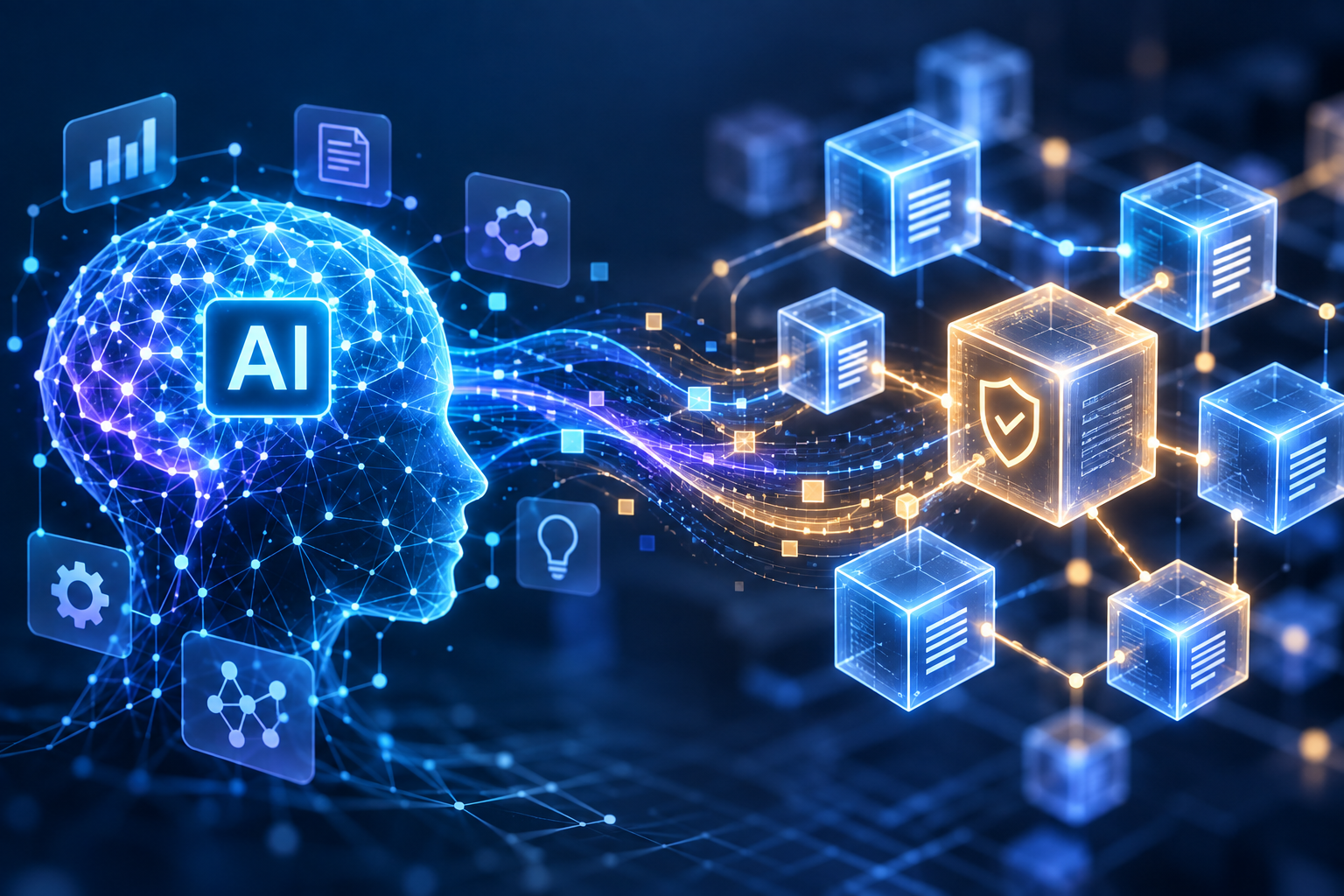
Artificial intelligence and blockchain are different technologies designed for different purposes. AI systems analyze data and automate tasks, while blockchain networks provide shared records, programmable transactions, and decentralized methods for verifying information.
Combining AI and blockchain does not automatically make either technology more secure, transparent, or decentralized. However, in certain applications, blockchain can provide verifiable records or transaction infrastructure while AI can analyze data, automate processes, or interact with blockchain-based applications.
This guide explains where the combination may be useful and examines its technical, security, and governance challenges.
How Blockchain Can Support AI Applications
Blockchain can provide infrastructure for recording and verifying certain information used by AI-related applications. Its usefulness depends on what data is placed on-chain, how the system is designed, and whether blockchain is actually appropriate for the use case.
- Data Provenance: Blockchain records can help document where certain data or digital assets originated and how they changed over time.
- Verifiable Records: Transactions, permissions, or selected events can be recorded on-chain so that authorized participants can independently verify them.
- Digital Ownership: Blockchain-based tokens and wallets can be used to represent ownership or access rights for certain digital assets.
- Payments and Incentives: Smart contracts and blockchain transactions can support payments or incentives between users, applications, and automated software agents.
- Shared Infrastructure: Applications involving multiple independent participants can use a blockchain as a common transaction or record-keeping layer.
Blockchain does not guarantee that AI-generated information is accurate or that an AI system is trustworthy. It can help verify specific records or transactions, but the quality of the underlying data and AI model still needs to be evaluated separately.
How AI Can Support Blockchain Applications
Blockchain networks generate large amounts of transaction and protocol data. AI and machine-learning systems can analyze this information to identify patterns, automate selected tasks, and assist with monitoring blockchain-based applications.
- Anomaly Detection: AI systems can help identify unusual transaction patterns or activity that may require further investigation.
- Blockchain Analytics: Machine learning can assist with organizing and analyzing large volumes of on-chain data.
- Security Monitoring: Automated systems can help detect suspicious behavior, although human review and additional security controls may still be necessary.
- Smart Contract Analysis: AI-assisted tools can help developers review code, identify potential issues, and support testing, but they should not replace independent security audits.
- User Interfaces: AI assistants can make complex blockchain data or application functions easier for users to understand and navigate.
Automated systems can help analyze blockchain applications, but their outputs can contain errors.Important security, financial, or governance decisions should not rely solely on AI-generated results.
Practical Uses for Both Technologies
These technologies can be combined where automated analysis or decision-making interacts with verifiable records, digital assets, or blockchain-based transactions.
- Data Provenance: Blockchain records can document the origin and history of selected datasets or digital content, while AI systems can analyze or process that information.
- Autonomous Software Agents: AI-powered agents can potentially use blockchain infrastructure to make payments, access digital services, or interact with smart contracts under predefined rules.
- Decentralized Data Markets: Blockchain-based systems can manage ownership, permissions, or payments related to datasets that may be used by AI applications.
- Digital Identity and Credentials: Verifiable blockchain records can support credentials or permissions that AI-enabled applications may need to check.
- Supply Chain Monitoring: AI can analyze operational data while blockchain records can provide a shared history of selected transactions or events.
- Decentralized Applications: AI features can be integrated into blockchain applications for analytics, automation, user assistance, or other specialized functions.
These use cases vary widely in maturity. In many situations, a conventional database or centralized service may be simpler and more efficient, so blockchain should be used only when its specific properties provide a meaningful benefit.
Potential Benefits of Combining the Two Technologies
The value of combining these technologies depends on the application. When the technologies address complementary problems, they can provide capabilities that may be difficult to achieve with either technology alone.
- Verifiable Records: Blockchain can provide records of selected transactions, permissions, or events that AI-enabled applications can reference.
- Data Provenance: Systems can use blockchain records to help track the origin and history of certain datasets or digital assets.
- Automated Transactions: AI-enabled software can interact with smart contracts to perform predefined blockchain transactions or processes.
- Digital Ownership: Tokens and blockchain accounts can represent ownership, access rights, or other digital relationships used by AI applications.
- Coordination Across Participants: Blockchain can provide shared infrastructure when multiple independent parties need access to a common record or transaction system.
These benefits are not automatic. The design of the AI system, blockchain network, smart contracts, data sources, and governance model determines whether the combination provides meaningful advantages.
Challenges and Limitations
Combining the two can introduce additional technical and operational complexity. Projects should consider whether the benefits justify the added infrastructure, cost, and security requirements.
- Scalability: Blockchain networks can have limitations in transaction speed, throughput, and cost, making it impractical to store or process large AI datasets directly on-chain.
- Data Quality: Blockchain can preserve records, but it cannot guarantee that the original data entered into a system is accurate or reliable.
- Privacy: AI applications may require large amounts of data, while public blockchains can make recorded information difficult or impossible to remove.
- Smart Contract Risk: Errors or vulnerabilities in smart contracts can create security and financial risks.
- AI Reliability: AI models can produce inaccurate, biased, or misleading outputs, even when blockchain records themselves are verifiable.
- Integration Complexity: Connecting AI models, off-chain data, blockchain networks, wallets, and smart contracts can increase development and maintenance requirements.
- Regulatory and Governance Issues: Data protection, digital assets, automated decision-making, and blockchain services may be subject to different legal requirements depending on the jurisdiction.
Each technology should therefore be evaluated separately first.. Combining them is most useful when each technology solves a specific problem that the application actually has.
Future Directions for Both Technologies
Both technologies continue to develop independently, while new applications explore ways to connect automated software with blockchain-based transactions and digital assets.
Potential areas of development include AI agents that interact with smart contracts, systems for verifying the provenance of digital content, blockchain-based payments between automated services, and tools that use AI to analyze on-chain activity.
However, widespread adoption will depend on practical benefits rather than the technologies simply being combined. Scalability, security, privacy, data quality, interoperability, and regulatory requirements will continue to influence which applications become useful in practice.
The most sustainable AI and blockchain applications are likely to be those where each technology has a clearly defined role and provides an advantage that simpler alternatives cannot easily provide.
Related Guides
- Blockchain Basics and Decentralized Network
- Blockchain vs Cryptocurrency: Understanding the Key Differences
- Blockchain Audit Integrity and Verification
- Understanding DeFi and Its Role in Crypto
Official Resources
- NIST AI Risk Management Framework
- Ethereum Smart Contracts Documentation
- NIST – Blockchain Technology Overview
FAQs
How can these technologies work together?
Automated systems can analyze data and perform selected tasks, while blockchain can provide shared records, programmable transactions, and digital asset infrastructure. Some applications combine these capabilities when both serve a specific purpose.
Can blockchain make AI more trustworthy?
Blockchain can help verify certain records, transactions, or data provenance, but it cannot guarantee that an AI model or its output is accurate, unbiased, or trustworthy.
Can AI improve blockchain security?
AI can assist with anomaly detection, transaction analysis, code review, and security monitoring. However, AI tools can make mistakes and should not replace independent security controls or smart contract audits.
Do AI applications need blockchain?
No. Many AI applications work effectively without blockchain. Blockchain is most relevant when an application specifically benefits from features such as shared verifiable records, digital ownership, smart contracts, or decentralized transactions.
What are the main risks of combining these technologies?
Important challenges include scalability, privacy, data quality, smart contract vulnerabilities, AI reliability, integration complexity, and regulatory or governance requirements.
Final Thoughts
These technologies can complement each other in certain applications, but combining them does not automatically make a system more secure, transparent, decentralized, or intelligent.
The most useful applications are those in which each technology has a clearly defined role. Artificial intelligence may provide analysis and automation, while blockchain can provide verifiable records, digital ownership, programmable transactions, or shared infrastructure.
Before using both technologies together, developers and users should consider whether the added complexity, cost, privacy concerns, and security risks are justified by a practical benefit.

 Bitcoin
  Ethereum
  Tether
  BNB
BNB  XRP
XRP  USDC
USDC  Solana
  TRON
TRON  Figure Heloc
  Zcash
Zcash