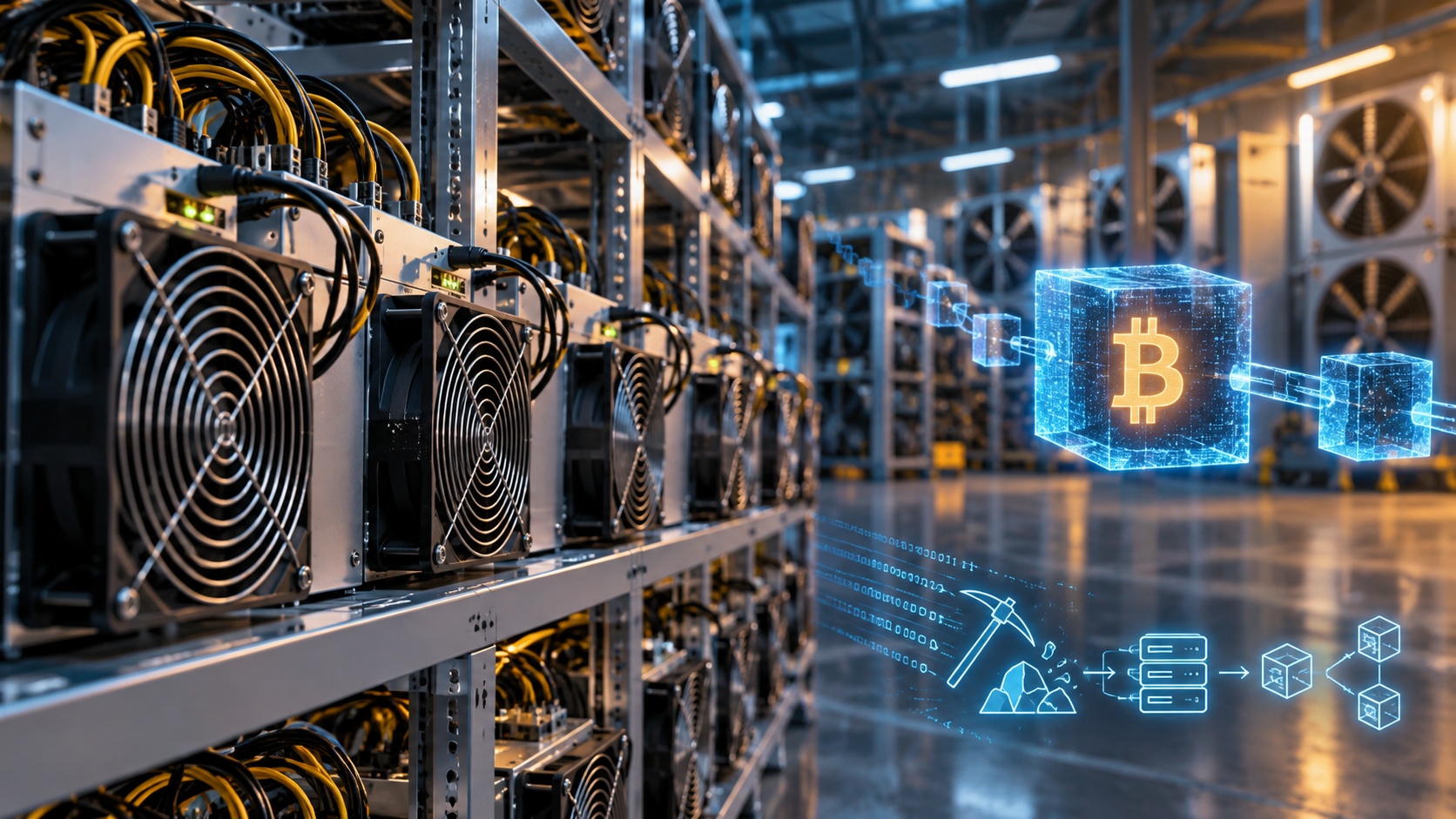
Bitcoin mining is the process that helps secure the Bitcoin network, confirm transactions, and add new blocks to the blockchain. Miners use specialized computing equipment to perform proof-of-work calculations and compete to produce a valid block.
Mining also plays an important role in Bitcoin’s monetary system. Successful miners can receive newly issued bitcoin and transaction fees as part of the block reward. This guide explains how Bitcoin mining works, the role of mining hardware and pools, and the costs and risks involved.
Understanding the Basics of Bitcoin Mining
Bitcoin mining is based on Bitcoin’s proof-of-work consensus mechanism. Miners use specialized computers to repeatedly perform cryptographic hash calculations. They attempt to find a block header that satisfies the network’s current difficulty target.
When a miner finds a valid block, it broadcasts the block to the Bitcoin network. Other nodes independently verify the block and its transactions before accepting it as part of the blockchain. The network periodically adjusts mining difficulty to help maintain an average block interval of approximately 10 minutes.
The Mining Process: Step-by-Step
- Transaction Selection: Miners select pending Bitcoin transactions and assemble them into a candidate block.
- Proof-of-Work Calculation: Mining hardware repeatedly performs hash calculations while changing values in the block header. The goal is to produce a hash below the network’s current difficulty target.
- Valid Block Discovery: When a miner finds a hash that satisfies the target, it has found a valid candidate block. The miner can then broadcast the block to the Bitcoin network.
- Network Verification: Bitcoin nodes independently check the block, its proof of work, and its transactions. They verify that the block follows the network’s consensus rules.
- Block Reward: If network nodes accept the block, the successful miner receives the block reward. This consists of the block subsidy plus eligible transaction fees included in the block.
Essential Bitcoin Mining Hardware
Today, miners generally rely on specialized hardware called ASICs (Application-Specific Integrated Circuits). These machines are designed specifically to perform the SHA-256 calculations used in Bitcoin mining and are far more efficient for this purpose than ordinary personal computers.
When evaluating mining hardware, important factors include hash rate, power consumption, energy efficiency, purchase cost, cooling requirements, reliability, and access to affordable electricity. Because mining technology changes over time, comparing current hardware specifications is more useful than relying on a fixed list of specific models.
The Role of Mining Pools
Mining pools allow individual miners to combine their computing power and work together to find valid Bitcoin blocks. When a pool successfully mines a block, it distributes the resulting reward among participating miners according to its payout method and each miner’s contributed work.
Joining a mining pool can provide more frequent and predictable payouts than mining independently, but miners should consider pool fees, payout rules, minimum withdrawal requirements, reliability, and the degree of control concentrated in large mining pools.
Is Bitcoin Mining Profitable?
Bitcoin mining profitability depends on several variables, including the price of bitcoin, network mining difficulty, hardware efficiency, electricity costs, cooling expenses, pool fees, and other operating costs. These factors can change substantially over time.
A mining operation that is profitable under one set of conditions may become unprofitable if electricity costs rise, mining difficulty increases, or bitcoin’s market price falls. For this reason, mining profitability should be evaluated using current costs and network conditions rather than assuming that mining will generate a profit.
Environmental Impact of Bitcoin Mining
Bitcoin mining requires substantial electricity because proof-of-work miners continuously operate specialized computing equipment. Its environmental impact depends not only on total electricity consumption but also on the sources of electricity used, the efficiency of mining equipment, and local energy conditions.
Some mining operations use renewable or otherwise low-carbon energy sources, while others rely on electricity generated from fossil fuels. Mining can also create additional environmental considerations, including cooling requirements, electronic waste from aging hardware, and effects on local electricity systems.
Related Guides
- What Is Bitcoin? Understanding the Revolutionary Digital Currency
- Blockchain Basics and Decentralized Network
Official Resources
- Bitcoin Developer Guide: Mining
- Bitcoin.org: Frequently Asked Questions
- U.S. EIA: Tracking Electricity Consumption from Cryptocurrency Mining
FAQs
How long does it take to mine one Bitcoin?
Bitcoin does not take a fixed amount of time to mine on an individual basis. The Bitcoin network is designed to produce a new block approximately every 10 minutes on average, but miners compete collectively to find each block. An individual miner’s expected results depend on factors such as hash rate, network difficulty, and whether the miner participates in a mining pool.
Can I mine Bitcoin using my personal computer?
Bitcoin mining is technically possible with general-purpose computers, but modern Bitcoin mining is dominated by specialized ASIC hardware. Ordinary desktop or laptop computers generally cannot compete efficiently with dedicated mining equipment and large-scale mining operations.
What is Bitcoin halving, and how does it affect mining?
Bitcoin halving is an event built into the Bitcoin protocol that reduces the block subsidy paid to miners by half approximately every 210,000 blocks. Halvings reduce the rate at which new bitcoin enters circulation and can affect mining economics because miners receive fewer newly issued bitcoin per block, while transaction fees remain a separate part of the block reward.
Final Thoughts
Bitcoin mining is a core part of the Bitcoin network, combining proof of work, specialized hardware, and economic incentives to help validate transactions and secure the blockchain.
However, mining also involves substantial costs and risks, including electricity consumption, hardware expenses, changing network difficulty, and bitcoin price volatility. Understanding these factors is important for evaluating how Bitcoin mining works and why mining conditions can change over time.

 Bitcoin
  Ethereum
  Tether
  BNB
BNB  XRP
XRP  USDC
USDC  Solana
  TRON
TRON  Figure Heloc
  Zcash
Zcash