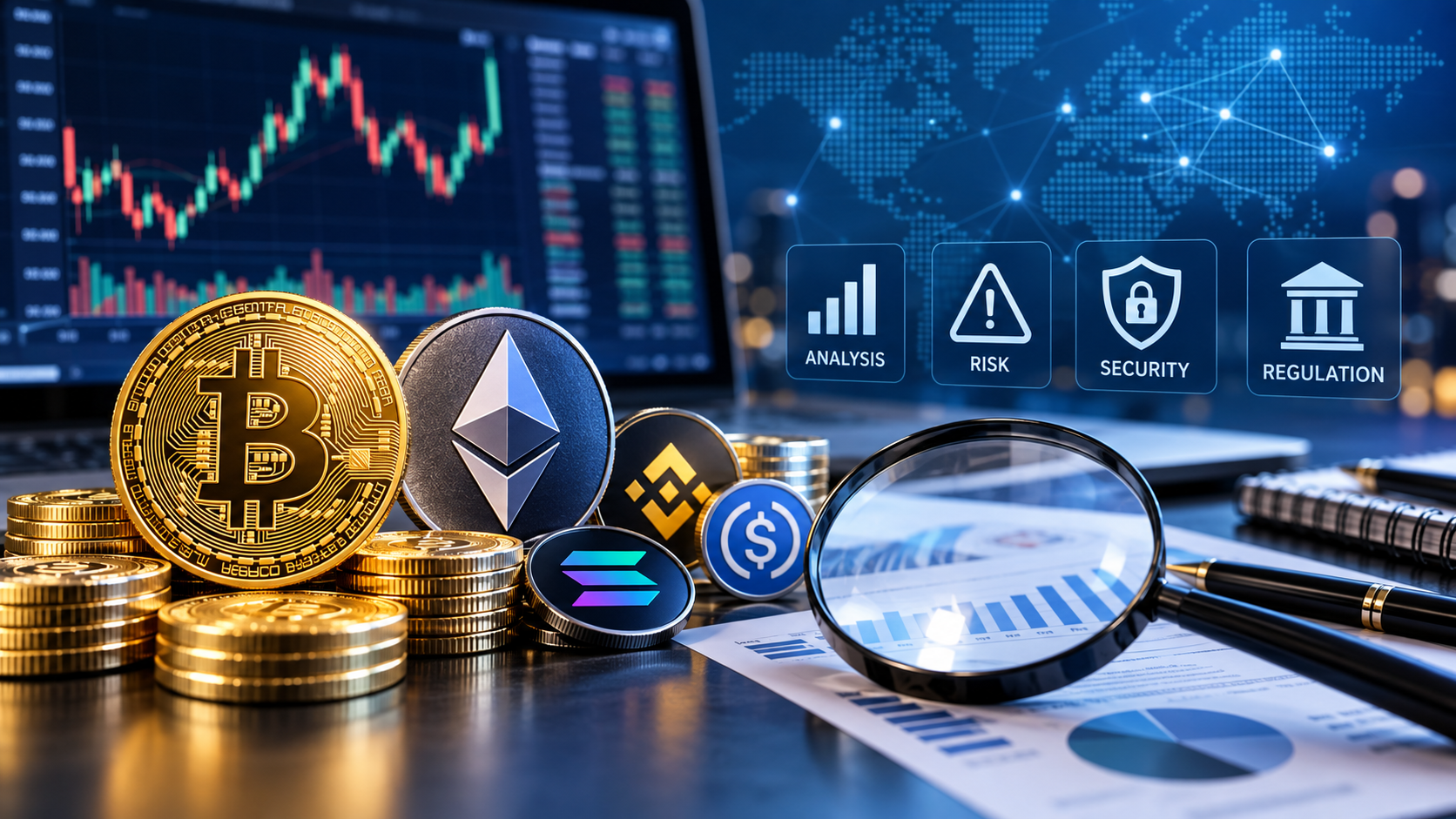
This crypto investing guide explains how to evaluate digital assets while considering the technology, market structure, custody, and risks that can affect an investment.
Some crypto assets are designed primarily to transfer value. Others provide access to blockchain networks, smart contract applications, decentralized finance, or other digital services. Their prices, utility, governance structures, and risks can vary substantially.
A careful approach to crypto investing therefore requires more than looking at recent price movements. Investors should understand what an asset does, how its network operates, how the asset is stored, and what risks could affect its value.
This crypto investing guide explains the major factors to examine before making an investment decision.
Understand What You Are Investing In
The term “crypto” covers many different types of digital assets.
Bitcoin, Ether, stablecoins, utility tokens, governance tokens, and other crypto assets may have very different purposes and economic structures.
Before evaluating an asset, ask several basic questions:
- What problem is the project designed to solve?
- Why does the network need a token?
- How is the token created and distributed?
- What gives users a reason to hold or use it?
- Who develops and governs the network?
- What are the major technical and financial risks?
Understanding the underlying asset is more useful than relying only on its market price or popularity.
Evaluate the Purpose and Utility
A crypto asset may have value within a network because it performs a particular function.
For example, a token may be used to:
- Pay network transaction fees
- Participate in network security
- Access blockchain-based services
- Provide liquidity to decentralized applications
- Participate in governance
- Transfer value between users
However, the existence of a use case does not guarantee that a token will increase in price.
Investors should examine whether people actually use the network and whether the token itself is necessary for that activity.
Examine Token Economics
Token economics, often called tokenomics, describes how a crypto asset is issued, distributed, and used.
Important factors can include:
- Maximum or total token supply
- Current circulating supply
- Future token issuance
- Token unlock schedules
- Ownership concentration
- Network incentives
- Token-burning mechanisms
- Staking rewards
Large future token releases can increase circulating supply. Highly concentrated ownership may also create additional market and governance risks.
Tokenomics should therefore be considered alongside the technology and real-world use of a project.
Look at Network Activity
A blockchain project may have impressive technology but limited actual usage.
Depending on the type of network, useful indicators can include:
- Active addresses
- Transaction activity
- Developer activity
- Applications built on the network
- Network fees
- Validator or miner participation
- Liquidity
- Stablecoin or asset activity
No single metric proves that a project is successful.
Metrics should instead be considered together to understand whether the network has meaningful and sustainable activity.
Understand Market Volatility
A crypto investing guide should emphasize that crypto markets can experience large price movements over short periods.
Prices may respond to changes in market liquidity, investor sentiment, leverage, regulation, security incidents, technological developments, or broader financial conditions.
Volatility can work in both directions.
A rapidly rising asset can also experience substantial declines, and historical returns do not establish what an asset will do in the future.
For this reason, price performance alone should not be used to judge the quality of a crypto project.
Consider Liquidity Risk
Liquidity describes how easily an asset can be bought or sold without substantially affecting its price.
Major crypto assets may trade across numerous markets, while smaller tokens can have much thinner liquidity.
Low liquidity can lead to:
- Larger bid-ask spreads
- Greater price movements
- Difficulty selling during market stress
- Increased vulnerability to manipulation
Reported trading volume should also be interpreted carefully because the quality and reliability of trading activity can differ between platforms.
Understand Custody and Wallet Risk
Owning crypto assets also requires deciding how they will be stored.
Self-Custody
With self-custody, the user controls the private keys required to access crypto assets.
This provides direct control but also places responsibility for protecting private keys and recovery information on the user.
Loss or theft of these credentials can result in permanent loss of access.
Third-Party Custody
Crypto exchanges and other custodians may hold assets on behalf of users.
This can be more convenient, but it introduces counterparty risk.
A custodian may experience security breaches, operational problems, withdrawal restrictions, financial failure, or other events that affect customers’ ability to access their assets.
Investors should understand how assets are held before selecting a custody method.
Evaluate Smart Contract and Technology Risk
Many crypto projects depend on smart contracts and complex software.
Potential technical risks include:
- Smart contract vulnerabilities
- Protocol design flaws
- Network outages
- Bridge vulnerabilities
- Oracle failures
- Wallet software vulnerabilities
- Governance attacks
Open-source code and security audits can provide useful information, but they cannot guarantee that software is free from vulnerabilities.
The more complex a blockchain application becomes, the more important it is to understand its technical dependencies.
Consider Regulatory Risk
Crypto regulation varies by jurisdiction and continues to develop.
Regulatory changes can affect:
- Crypto exchanges
- Token issuers
- Stablecoins
- Custody providers
- Staking services
- Decentralized finance
- Tax treatment
- Access to particular products
A crypto asset that operates globally may still be subject to different rules depending on where its users, developers, issuers, or service providers are located.
Investors should therefore consider the legal and regulatory environment relevant to their own jurisdiction.
Watch for Scams and Misleading Claims
Crypto markets have attracted numerous forms of fraud and misleading promotion.
Warning signs can include:
- Guaranteed returns
- Claims of risk-free profits
- Pressure to invest immediately
- Unsolicited investment messages
- Fake trading platforms
- Celebrity or influencer promotions without adequate disclosure
- Requests to transfer crypto to unfamiliar wallet addresses
- Promises that an investment cannot lose value
A professional-looking website or active social media account does not prove that a project is legitimate.
Independent verification is essential before transferring money or crypto assets.
Compare Crypto With Other Investments
Crypto assets should not be evaluated in isolation.
Traditional investments such as stocks and bonds have different sources of value and different risk characteristics.
A stock can represent ownership in a company and may provide claims on earnings or assets. A bond generally represents a debt obligation with defined contractual terms.
Many crypto assets do not provide equivalent ownership or contractual rights.
Their value may instead depend on network usage, scarcity, market demand, protocol incentives, or expectations about future adoption.
Understanding these differences helps investors compare crypto exposure with other parts of a portfolio.
Think About Portfolio Risk
The appropriate level of crypto exposure depends on an individual’s financial circumstances, objectives, time horizon, and ability to tolerate losses.
Because many crypto assets can be highly volatile, investors should consider how a substantial decline would affect their overall financial position.
Questions worth considering include:
- Could I tolerate losing a significant portion of this investment?
- Do I understand why I am buying this asset?
- Am I relying on short-term price predictions?
- Is my investment concentrated in one asset or sector?
- Do I understand how the asset will be stored?
- Have I independently verified the project and platform?
These questions do not determine whether an investment will succeed, but they can help identify risks before capital is committed.
Crypto Investing Guide: Practical Checklist
This crypto investing guide uses the following checklist to review the most important areas before considering a crypto asset:
Project
Understand the project’s purpose, technology, development team, and competitive environment.
Token
Review token supply, distribution, utility, unlock schedules, and ownership concentration.
Network
Examine real network usage, developer activity, security, and decentralization.
Market
Consider liquidity, volatility, trading venues, and market structure.
Custody
Understand who controls the private keys and what happens if a wallet or custodian fails.
Regulation
Consider applicable rules, restrictions, and tax obligations.
Risk
Decide how much loss you could realistically tolerate before investing.
A checklist cannot eliminate investment risk, but it can encourage a more structured evaluation process.
Related Guides
- What Is Cryptocurrency? How Digital Money and Crypto Assets Work
- Understanding Blockchain Basics: A Beginner’s Guide
- Web3 Crypto Coins Explained: Key Projects, Uses and Risks
Official Resources
- Investor.gov: Crypto Assets
- Investor.gov: Crypto Asset Custody Basics
- FINRA: Crypto Assets
- Bitcoin Developer Documentation
FAQs
Is cryptocurrency a safe investment?
Crypto assets can involve substantial risk, including price volatility, custody failures, fraud, technical vulnerabilities, and regulatory changes. Risk varies considerably between assets and platforms.
Can crypto investments lose all their value?
Yes. A crypto asset can lose a substantial portion or potentially all of its market value if demand disappears, a project fails, fraud occurs, or other serious problems develop.
What should I research before buying cryptocurrency?
Consider the project’s purpose, token economics, network activity, security, liquidity, custody arrangements, regulatory environment, and major competitors.
Is keeping crypto on an exchange safe?
Using an exchange can be convenient, but it introduces third-party custody risk. Users should understand how the provider stores assets, what protections apply, and what could happen if the provider fails.
Does blockchain technology make crypto investments secure?
Blockchain technology can provide particular security properties, but it does not eliminate investment risk. Wallet theft, smart contract vulnerabilities, scams, custody failures, market losses, and other risks can still occur.
Final Thoughts
A crypto investing guide should consider both technology and financial risk.
Blockchain networks can support new ways to transfer value and build digital services, but technological innovation does not guarantee investment returns.
A disciplined approach focuses on understanding the asset, verifying claims, examining token economics and network activity, considering custody and regulatory risks, and determining how potential losses would affect the broader portfolio.
The goal is not to predict which crypto asset will rise next. It is to understand what you are investing in and what could go wrong before making a financial decision.

 Bitcoin
  Ethereum
  Tether
  BNB
BNB  XRP
XRP  USDC
USDC  Solana
  TRON
TRON  Figure Heloc
  Zcash
Zcash