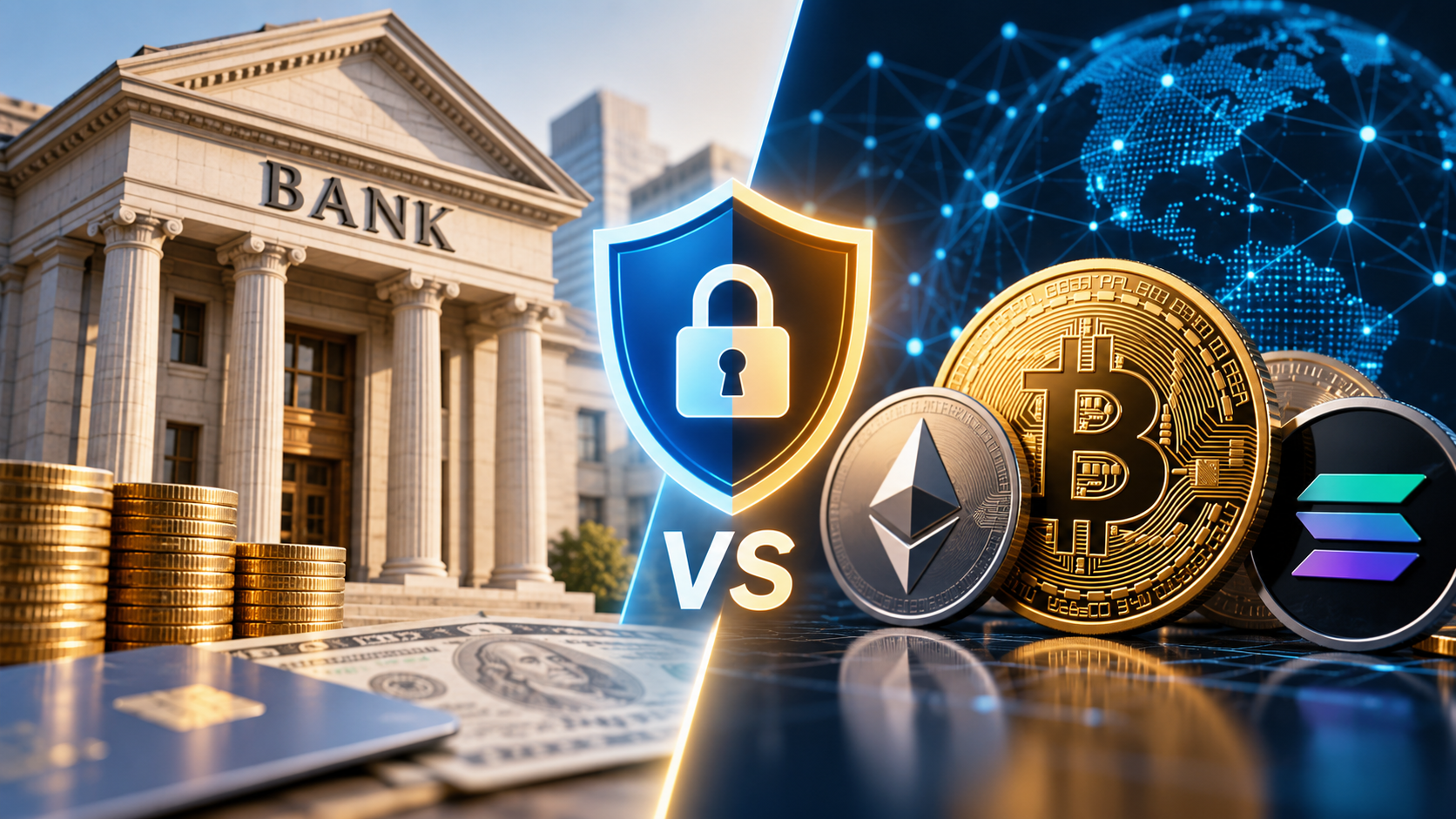
Cryptocurrency vs banks is an important security comparison because the two systems protect money in very different ways. Banks rely on regulated institutions, centralized security systems, and consumer protection rules. Cryptocurrencies rely on blockchain networks, cryptography, and users who often control their own assets.
So, is cryptocurrency safer than a bank? There is no simple answer. The risks depend on where assets are stored, how they are accessed, and what protections are available when something goes wrong.
This guide compares cryptocurrency and banks across security, fraud, custody, regulation, privacy, and consumer protection.
How Cryptocurrency Security Works
Most cryptocurrencies operate on blockchain networks. A blockchain records transactions across a distributed network rather than relying on a single bank or payment processor.
Cryptography helps protect transaction records, while network participants follow consensus rules to validate transactions.
Major blockchain networks can be difficult to alter because changing confirmed records may require enormous computational or economic resources.
However, blockchain security does not automatically protect every part of the cryptocurrency ecosystem. Exchanges, wallets, smart contracts, and individual users can still face security risks.
How Banks Protect Customer Money
Banks use centralized systems to manage accounts and process transactions. This creates different risks but also provides several layers of protection.
Banks typically use measures such as:
- Identity verification
- Encryption
- Fraud monitoring
- Multi-factor authentication
- Transaction controls
- Regulatory compliance
- Internal security systems
Customers can also contact their bank when they notice suspicious transactions or lose access to an account.
Depending on the country and circumstances, banking regulations may provide additional consumer protections.
Cryptocurrency vs Banks: Custody and Asset Control
One of the biggest differences involves who controls the assets.
With a traditional bank account, the bank maintains the account infrastructure and controls access to its systems.
Cryptocurrency can work differently.
Users who keep cryptocurrency in a self-custody wallet control their assets through private keys. This reduces dependence on a financial institution, but it also creates personal responsibility.
If someone loses a private key or recovery phrase, recovering the cryptocurrency may be impossible.
Cryptocurrency held on a centralized exchange introduces another type of custody risk because the exchange controls the private keys associated with customer assets.
Can Cryptocurrency Transactions Be Reversed?
Blockchain transactions are generally difficult or impossible to reverse after the network confirms them.
This can reduce certain forms of payment reversal fraud, but it creates another problem.
If a user sends cryptocurrency to the wrong address or sends funds to a scammer, there may be no institution capable of reversing the transaction.
Banking systems often provide more options for investigating disputed or unauthorized transactions, although the available protection depends on the payment method, jurisdiction, and circumstances.
Are Blockchains Vulnerable to Hacking?
People sometimes describe blockchains as impossible to hack, but that description is too broad.
A well-established blockchain network may have strong resistance to manipulation. However, attackers do not always need to attack the blockchain itself.
They may target:
- Cryptocurrency exchanges
- Wallet software
- Smart contracts
- Bridges between blockchains
- User passwords
- Private keys
- Recovery phrases
Phishing and social engineering can also trick users into voluntarily giving attackers access to their assets.
Therefore, the security of a blockchain should not be confused with the security of every application built around it.
Bank Security Risks
Banks also face cyberattacks, account takeovers, identity theft, payment fraud, and data breaches.
Because banks store large amounts of financial and personal information, they can become attractive targets for attackers.
Centralization can create concentrated risk because a successful attack against an important system may affect many customers.
However, financial institutions usually maintain dedicated security teams, monitoring systems, compliance programs, and procedures for responding to suspicious activity.
Consumer Protection
Consumer protection is one of the most important differences between cryptocurrency and traditional banking.
Bank customers may benefit from laws and regulations governing deposits, unauthorized transactions, fraud investigations, and financial institutions.
The exact protections vary by country and account type.
Cryptocurrency protections are less consistent. A user who loses cryptocurrency because of a compromised private key, fraudulent token, failed platform, or mistaken transfer may have limited options for recovery.
This makes understanding custody particularly important for cryptocurrency users.
Deposit Insurance and Cryptocurrency
Traditional bank deposits may qualify for government-backed deposit insurance, subject to local rules and coverage limits.
Cryptocurrency generally does not receive the same protection simply because a user holds it on an exchange or in a wallet.
Some cryptocurrency companies may maintain private insurance for particular risks, but such coverage should not be confused with government-backed bank deposit insurance.
Users should verify what protection actually applies rather than assuming that all assets on a financial platform receive the same coverage.
Cryptocurrency vs Banks: Privacy Differences
Cryptocurrency can provide a different form of financial privacy, but it is not necessarily anonymous.
Many public blockchains permanently display transaction histories. Addresses may appear as strings of characters rather than personal names, but blockchain analysis can sometimes connect addresses with individuals or organizations.
Banks generally collect identifying information under Know Your Customer and Anti-Money Laundering requirements.
As a result, bank transactions usually occur within systems where financial institutions know the identity of their customers.
The two systems therefore involve different privacy trade-offs rather than a simple choice between private and non-private transactions.
Cryptocurrency Scams and Fraud
Cryptocurrency markets can expose users to scams that differ from traditional banking fraud.
Common risks include:
- Fake investment platforms
- Phishing websites
- Fraudulent tokens
- Impersonation scams
- Ponzi-style schemes
- Malicious wallet applications
- Fake giveaways
- Smart contract exploits
The speed and irreversibility of cryptocurrency transfers can make stolen funds difficult to recover.
Users should independently verify platforms, wallet addresses, and investment claims before transferring cryptocurrency.
Volatility Is Also a Risk
Security does not only mean protection from hackers.
Cryptocurrency prices can fluctuate substantially. An asset may remain technically secure on a blockchain while losing a large percentage of its market value.
Money held in a bank account usually does not experience the same type of market-price volatility, although inflation and other financial risks can affect its purchasing power.
Therefore, cybersecurity and investment risk should be considered separately.
When Cryptocurrency May Offer Advantages
Cryptocurrency can offer useful features in certain situations.
Blockchain networks can allow users to transfer digital assets without relying on a traditional bank as the direct transaction intermediary.
Some networks operate continuously and support global transfers. Self-custody can also give users direct control over digital assets.
These advantages come with responsibilities. Users must understand wallet security, transaction verification, private-key management, and the risks associated with the platforms they use.
When Banks May Offer Advantages
Banks may be more suitable when users prioritize consumer protection, account recovery, established payment infrastructure, and regulatory oversight.
Customers generally do not need to manage cryptographic private keys themselves.
Banks can also provide services such as mortgages, credit cards, business loans, payment processing, and insured deposit accounts that extend beyond simple asset storage.
How to Reduce Cryptocurrency Security Risks
People who use cryptocurrency can reduce some risks through basic security practices.
Use strong, unique passwords and enable multi-factor authentication when available.
Never share a private key or recovery phrase. Carefully verify wallet addresses before sending funds, and be cautious about links received through email, social media, or messaging services.
For significant holdings, users may also consider whether self-custody or specialized hardware wallets fit their knowledge and security needs.
No security method eliminates every risk.
Cryptocurrency vs Banks: Key Security Differences
When comparing cryptocurrency vs banks, the key security differences involve custody, recovery, regulation, and consumer protection.
Banks generally provide stronger institutional support, account recovery procedures, regulatory oversight, and established consumer protections.
Cryptocurrency can provide direct ownership, decentralized settlement, and reduced dependence on traditional financial intermediaries.
At the same time, cryptocurrency often places greater responsibility on the individual user.
The security of cryptocurrency therefore depends not only on blockchain technology but also on wallets, exchanges, smart contracts, custody choices, and user behavior.
Risks to Consider
Before holding cryptocurrency, consider several separate risks:
Custody Risk
Who controls the private keys?
Exchange Risk
What happens if the platform holding the cryptocurrency fails or restricts withdrawals?
Cybersecurity Risk
Could phishing, malware, or account theft compromise access?
Smart Contract Risk
Does the asset depend on software that could contain vulnerabilities?
Market Risk
Could the asset lose substantial value?
Regulatory Risk
Could changes in laws or regulations affect access, trading, or use?
Understanding these risks is more useful than assuming that cryptocurrency or banks are universally safer.
Related Guides
- Crypto Wallet Types Explained: Choosing the Right One for You
- How to Protect Your Private Keys: Essential Tips for Crypto Security
- Top 10 Cryptocurrency Security Tips: Protect Your Digital Assets
Official Resources
FAQs
Is cryptocurrency safer than keeping money in a bank?
Not in every situation. Cryptocurrency and banks have different security models. Banks generally provide more institutional and consumer protections, while cryptocurrency can provide direct control over digital assets.
Can cryptocurrency be hacked?
Attackers can compromise exchanges, wallets, smart contracts, accounts, and users even when the underlying blockchain remains secure.
Can stolen cryptocurrency be recovered?
Sometimes, but recovery can be difficult. Blockchain transactions are generally irreversible, and recovery depends on the circumstances and whether an exchange, law-enforcement agency, or other party can intervene.
Is money in a bank completely safe?
No financial system is completely risk-free. Banks can experience fraud, cyberattacks, operational failures, and other problems, although regulations and consumer protections may reduce some risks.
Is a hardware wallet safer than a cryptocurrency exchange?
A hardware wallet can reduce some online custody risks when used correctly, but self-custody introduces responsibility for protecting private keys and recovery phrases. The appropriate choice depends on the user’s knowledge and circumstances.
Final Thoughts
Cryptocurrency vs banks involves two very different approaches to financial security.
Banks rely heavily on regulated institutions, centralized security systems, account recovery procedures, and consumer protections. Cryptocurrency relies more heavily on cryptography, blockchain networks, and individual control of digital assets.
Neither system eliminates risk.
For cryptocurrency users, understanding custody, private keys, scams, exchange security, and transaction irreversibility is essential. For bank customers, strong passwords, multi-factor authentication, and careful monitoring of accounts remain important.
Rather than asking whether cryptocurrency or banks are always safer, it is more useful to identify which risks each system reduces—and which risks the user must manage personally.

 Bitcoin
  Ethereum
  Tether
  BNB
BNB  XRP
XRP  USDC
USDC  Solana
  TRON
TRON  Figure Heloc
  Zcash
Zcash