

Ethereum can support payments, digital assets, and applications without relying on a single company to maintain its transaction history. However, using Ethereum Mainnet for every action can become expensive when demand rises. Ethereum Layer 2 networks aim to make everyday transactions more practical by processing activity outside Mainnet while using Ethereum for important security and settlement functions.
What does “Layer 2” mean in practice? This guide explains how rollups work, why their fees can be lower, how funds move between networks, and which risks to check before using one.
What Is Ethereum Layer 2?
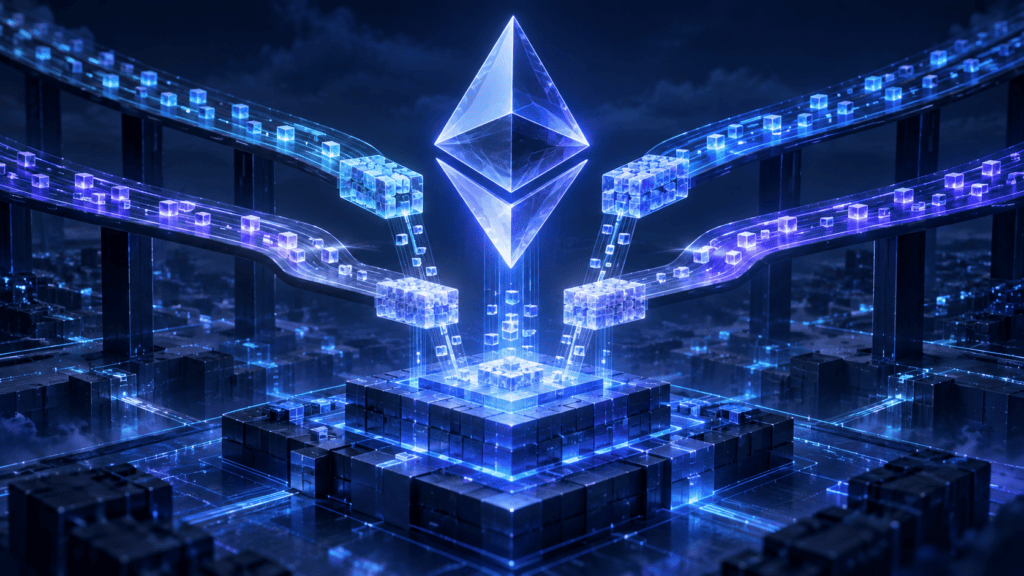
Ethereum Mainnet is often called Layer 1, or L1. A Layer 2 network, or L2, operates alongside it and handles transactions through a separate system. The aim is to serve more users without requiring every transaction to undergo all its processing directly on Mainnet.
Many Ethereum L2 networks use rollups. A rollup processes a group of transactions and publishes information to Ethereum so that its results can be checked or finalized under the rollup’s rules. Designs differ, so the phrase “Layer 2” alone does not tell you exactly how a network works or how mature its security features are.
An L2 is also a distinct network in your wallet. An ETH balance on Ethereum Mainnet and an ETH balance on an L2 are in different locations. You must select the correct network before sending or receiving funds.
Why Does Ethereum Need Layer 2 Networks?
Ethereum has limited capacity for transactions directly on Mainnet. When many people want to use that capacity at once, they compete for space, and fees can increase. This can make a small payment or application interaction impractical.
Rollups spread some costs across many transactions. They perform much of the work outside Mainnet, then use Ethereum to publish data, verify results, or settle disputes according to their design. As a result, an individual L2 transaction may cost less than a comparable Mainnet transaction.
Lower fees are possible, not guaranteed. Costs still depend on network activity, the type of transaction, the rollup’s design, and the price of the resources it uses.
How Do Rollups Work?
Imagine that hundreds of people use an application on a rollup. The rollup records and processes their activity, groups transactions into batches, and sends the information required by its system to Ethereum. Ethereum serves as the base layer for settlement and for the rollup’s security mechanisms.
A useful way to understand a rollup is to ask three questions:
- Where are transactions processed? The rollup performs transaction execution outside Ethereum Mainnet.
- What does it publish to Ethereum? The answer depends on its design, but transaction data and information about the resulting state matter.
- How are incorrect results prevented or challenged? Different rollups use different proof and dispute mechanisms.
The details matter. Two networks may both call themselves rollups while having different operators, withdrawal procedures, upgrade controls, and security assumptions.
Optimistic Rollups vs. ZK Rollups
Optimistic Rollups
An optimistic rollup generally treats a submitted batch as valid unless someone challenges it during a specified period. Its system provides a way to dispute an incorrect result. This challenge period helps explain why a withdrawal from some optimistic rollups to Ethereum Mainnet can take longer than users expect.
The exact withdrawal time and available alternatives depend on the network. A third-party bridge may offer a faster route, but it introduces its own costs and risks.
ZK Rollups
A zero-knowledge rollup, usually called a ZK rollup, submits a cryptographic validity proof for its proposed state changes. Ethereum checks the proof as part of accepting the rollup’s result.
This approach differs from waiting for a challenge to an invalid batch. Still, “ZK” does not mean every withdrawal is instant or every implementation carries identical risks. Proof generation, network operation, smart contracts, and bridge design can all affect the user experience. ethereum.org
Why Are Layer 2 Fees Often Lower?
A Mainnet transaction pays for activity performed and recorded under Ethereum’s own capacity limits. A rollup can divide some of its Ethereum costs among many users. It may also compress the information it sends to Mainnet.
Ethereum’s Dencun upgrade introduced blobs, a way for rollups to publish certain data in temporary space with a separate fee market. Blobs help reduce data publication costs when that space is economical to use. They are part of Ethereum’s scaling strategy; they do not make every L2 transaction free or directly lower every Mainnet gas fee. ethereum.org
A user’s final fee may include costs for L2 execution, publishing data to Ethereum, and operating the network. Fees can change as demand and these underlying costs change.
How Do You Move Funds to a Layer 2?
You can generally reach an L2 by withdrawing through an exchange that supports that specific network or by using a bridge. The appropriate method depends on where your funds are now and where you want them to arrive.
Before confirming a transfer:
- Check the asset and the destination network.
- Confirm that the receiving wallet or exchange supports both.
- Read the displayed fees and expected arrival time.
- For a new route, consider a small test transfer first.
- Use the network’s official documentation to verify its bridge address or website.
A bridge transfers value between networks according to its own rules. Bridging is therefore a separate action from sending tokens to another address on the same network. Sending an asset over an unsupported network can make recovery difficult or impossible.
Are Layer 2 Networks as Safe as Ethereum Mainnet?
An L2 may use Ethereum for settlement and security, but that does not remove every additional risk. Its contracts, operators, proof system, bridge, and upgrade controls can affect how safely users can transact or withdraw.
One question is whether a single sequencer currently orders transactions. Another is whether users have a practical way to exit if that operator stops working or refuses a transaction. You should also check who can upgrade the network’s contracts and whether restrictions apply to withdrawals.
An L2’s security properties can change as its software and governance evolve. Review the specific network’s current documentation instead of assuming that every network described as “Ethereum Layer 2” offers the same protections.
Key Risks to Check Before Using an L2
- Bridge risk: A bridge or its contracts may have vulnerabilities. Third-party bridges add another system to evaluate.
- Smart contract risk: Bugs in L2 contracts or applications can put funds at risk.
- Operator risk: A sequencer outage or censorship may interrupt normal transactions.
- Upgrade risk: People or organizations with upgrade permissions may be able to change critical contracts.
- Withdrawal delays: Returning funds to Mainnet may take time, particularly when a challenge period applies.
- Wrong-network transfers: A wallet address alone does not confirm that the destination supports your chosen network.
- Token confusion: A network’s transaction fee token and any separate governance token may serve different purposes.
These risks do not mean every L2 is unsuitable. They mean that lower fees should be considered alongside the network’s design and the needs of the transaction.
How to Compare Ethereum Layer 2 Networks
Start with the activity you plan to perform. Check whether the application and asset you need are available on the L2. Then compare transaction fees, bridge and withdrawal costs, expected withdrawal times, and wallet support.
Next, review the network’s official explanations of its proof system, data publication, sequencer, upgrades, and exit options. If you intend to hold substantial assets there, these details deserve more attention than a promotional claim about transaction speed.
Finally, distinguish the usefulness of an L2 network from the potential value of a token associated with it. A network can process transactions successfully without guaranteeing that a particular token will appreciate.
Related Guides
- Ethereum 2.0 Explained: What Changed After The Merge
- Understanding Blockchain Basics: A Beginner’s Guide
- Smart Contracts Explained: How They Work and Why They Matter
- Crypto Wallet Types Explained: Choosing the Right One for You
Official Resources
- Ethereum.org — Introduction to L2
- Ethereum.org — Optimistic Rollups
- Ethereum.org — Zero-Knowledge Rollups
FAQs
Is Ethereum Layer 2 the same as Ethereum Mainnet?
No. An L2 is a separate network that uses Ethereum in its design. Your wallet must show the correct network for the assets you want to use.
Did The Merge make Layer 2 fees cheaper?
The Merge changed Ethereum’s consensus mechanism from proof of work to proof of stake. It did not directly make Mainnet gas fees cheaper. Rollups and later scaling upgrades address different parts of the capacity and cost problem.
Do I need a different wallet for an L2?
Many wallets support multiple networks, so a separate wallet may be unnecessary. You still need to select the correct network and check that your wallet supports it.
Are all rollups equally secure?
No. Their proof systems, operators, data publication, contracts, upgrade permissions, and exit options can differ.
Can I withdraw from an L2 immediately?
It depends on the network and withdrawal route. Some native withdrawals involve a waiting period; faster third-party routes may carry additional fees or risks.
Final Thoughts
Ethereum Layer 2 networks offer ways to process more activity while continuing to use Ethereum for important settlement and security functions. Rollups can lower costs, but their designs and protections vary.
Before moving funds, confirm the asset and network, review the bridge and withdrawal process, and check the particular L2’s current documentation. The best choice depends on what you need to do and which risks you are prepared to accept.