


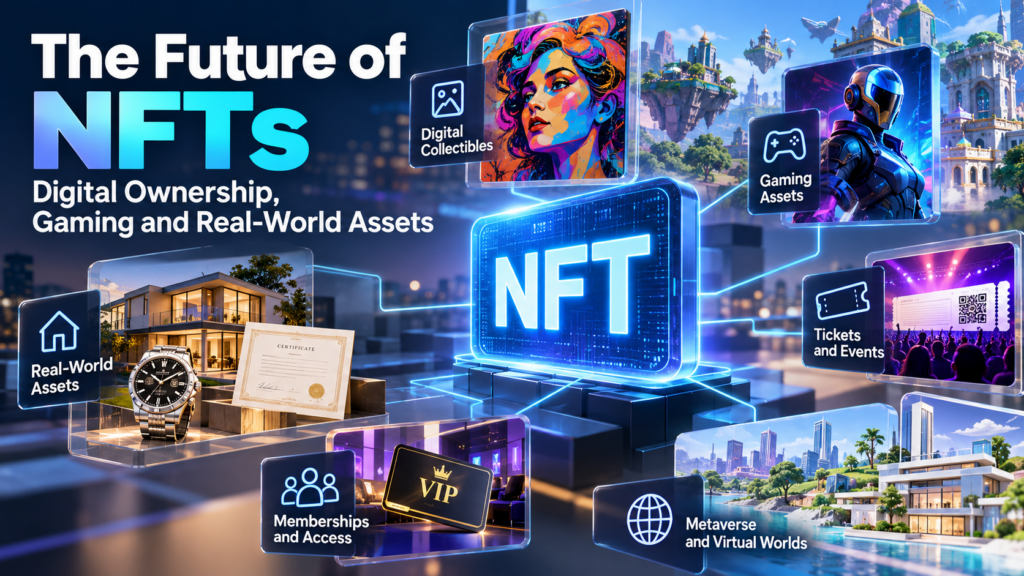
The future of NFTs is no longer limited to digital artwork and online collectibles. Non-fungible tokens can represent unique digital records, ownership rights, access privileges, gaming assets, memberships, and links to real-world assets.
NFT activity has changed considerably since the speculative boom of 2021 and 2022. Trading volumes and prices can rise and fall dramatically, but the underlying technology continues to be explored for applications where uniqueness, provenance, transferability, and programmable ownership may be useful.
This guide examines the future of NFTs, how the technology works, where it may be used, and the risks that could determine whether NFT-based applications achieve broader adoption.
What Is an NFT?
NFT stands for non-fungible token.
A fungible asset can generally be exchanged for another equivalent unit. One bitcoin, for example, is interchangeable with another bitcoin of the same amount.
An NFT is different because each token can have a distinct identifier and associated information.
NFTs are typically recorded on blockchains using smart contracts. Depending on the design, a token may contain or reference information about an artwork, game item, membership, ticket, certificate, or another digital or physical asset.
Owning an NFT does not automatically mean owning every legal right associated with the underlying item. Copyright, commercial rights, physical ownership, and contractual rights depend on the terms attached to the specific project.
How NFTs Create Digital Ownership
Digital files can be copied easily.
An NFT does not prevent an image, video, or other digital file from being copied. Instead, it can provide a blockchain-based record associated with a particular token.
This record can show information such as:
- Token identifier
- Current blockchain address
- Transaction history
- Smart contract
- Token metadata
- Previous transfers
This can create a verifiable history for certain digital assets, although the reliability of that history still depends on how the NFT was originally created and what information it represents.
NFTs and Digital Collectibles
Digital collectibles were among the earliest widely recognized NFT applications.
Collections can include artwork, profile pictures, sports-related items, virtual objects, and other limited digital assets.
Blockchain records can make it possible to verify which wallet currently controls a particular token and trace previous transfers.
However, scarcity alone does not guarantee economic value.
The value of a collectible can depend on demand, community interest, creator reputation, cultural relevance, liquidity, and broader market conditions.
The Future of NFTs in Gaming
Gaming is frequently discussed as a potential long-term application for NFTs.
Traditional games often contain digital items such as:
- Characters
- Skins
- Weapons
- Land
- Collectibles
- Access passes
In conventional games, these assets usually remain within systems controlled by the game developer.
Blockchain-based assets can potentially allow players to hold certain game items in their own wallets and transfer them according to the rules of the underlying smart contract.
This does not mean every game needs NFTs.
Developers must consider user experience, transaction costs, security, game balance, speculation, and whether blockchain ownership provides a genuine benefit to players.
Interoperability Between Games and Platforms
One proposed benefit of blockchain-based gaming assets is interoperability.
In theory, an NFT could be recognized by multiple games or digital platforms.
In practice, interoperability is technically difficult.
Different games use different graphics, rules, economies, databases, and intellectual property. Owning a token does not automatically make an item compatible with another game.
Future interoperability may therefore depend less on transferring identical objects between unrelated games and more on shared identity, achievements, memberships, or access rights across connected ecosystems.
NFTs in the Metaverse and Virtual Worlds
Virtual worlds can contain digital land, buildings, clothing, identities, event tickets, and other assets.
NFTs can potentially represent some of these objects.
A blockchain-based ownership layer may allow users to hold and transfer certain assets independently of a platform’s internal database.
However, the usefulness of these assets still depends heavily on the continued operation and popularity of the underlying virtual environment.
Owning a blockchain token cannot guarantee that a particular platform, game, or virtual world will continue operating.
NFTs and Real-World Assets
Another area of development involves connecting tokens with physical or traditional assets.
An NFT could potentially be associated with:
- Artwork
- Collectibles
- Luxury goods
- Property records
- Certificates
- Event tickets
- Membership rights
- Product authenticity records
This concept is sometimes described as tokenization.
The difficult part is not simply creating a token. A reliable system must establish the legal and practical relationship between the blockchain token and the underlying asset.
Without that connection, possession of an NFT may not provide enforceable ownership of the physical item it supposedly represents.
NFTs for Tickets and Events
NFT technology can also be used for digital tickets.
A blockchain-based ticket could potentially provide a record of issuance and transfer.
Smart contracts may allow event organizers to establish rules around resale, access, or additional benefits.
NFT tickets could also become digital collectibles after an event.
However, blockchain ticketing must compete with conventional ticketing systems that are already familiar to users and capable of processing large transaction volumes.
Adoption therefore depends on whether blockchain technology solves a meaningful problem rather than simply adding technical complexity.
Memberships and Digital Access
NFTs can function as access credentials.
A token may provide access to:
- Online communities
- Events
- Digital content
- Games
- Membership benefits
- Products or services
This approach is sometimes called token-gated access.
Because ownership can be checked through a blockchain wallet, access privileges may be transferable or programmable.
Projects using this model still need to manage security, privacy, lost wallets, customer support, and legal obligations.
NFTs and Digital Identity
NFT-related technology may also contribute to blockchain-based identity systems.
Tokens or similar blockchain credentials could potentially represent qualifications, achievements, memberships, or other attestations.
However, identity applications raise significant privacy issues.
Public blockchains are transparent by design, while personal information often requires confidentiality.
For this reason, future digital identity systems may combine blockchain records with privacy technologies rather than storing sensitive personal information directly on public blockchains.
Creator Royalties and NFTs
NFT smart contracts can be designed to include information related to creator royalties.
The original idea was that creators could potentially receive compensation when their digital works were resold.
In practice, royalty enforcement can depend on marketplaces and smart contract implementation.
A royalty rule written into one system may not necessarily be honored by every marketplace or transfer method.
NFTs therefore provide tools for creator economics, but they do not automatically guarantee royalty payments.
Dynamic NFTs
Some NFTs can change based on external information or predefined conditions.
These are sometimes called dynamic NFTs.
For example, metadata might change according to:
- Game progress
- Event results
- Membership status
- Time
- External data
- User activity
Dynamic NFTs could make tokens more interactive than static collectibles.
Their reliability may depend on smart contracts and, in some cases, external data services known as oracles.
NFTs and Artificial Intelligence
Artificial intelligence and NFTs can intersect in several ways.
AI systems can generate images, music, virtual characters, and other digital content that may be associated with blockchain tokens.
NFTs could also potentially represent access rights or provenance records for certain digital assets.
However, combining AI-generated content with NFTs raises questions about copyright, authorship, licensing, authenticity, and the source of training data.
Blockchain records can show information about a token, but they cannot by themselves determine whether the underlying content was legally created or licensed.
NFT Marketplaces May Continue to Evolve
NFT marketplaces allow users to discover, buy, sell, and transfer tokens.
Future marketplaces may place greater emphasis on:
- Better security
- Clearer ownership information
- Lower transaction costs
- Cross-chain support
- Creator tools
- Regulatory compliance
- User-friendly wallets
- Verification of physical assets
Marketplaces may also become more specialized.
Instead of one platform attempting to serve every type of NFT, different services may focus on gaming, art, ticketing, memberships, real-world assets, or professional applications.
The Role of Layer 2 Networks
Transaction fees and network capacity can affect NFT usability.
Layer 2 networks and other scaling technologies are designed to process transactions more efficiently while using an underlying blockchain for settlement or security.
Lower costs can be particularly important for applications involving large numbers of low-value transactions, such as games or digital tickets.
The future of NFTs may therefore depend partly on blockchain infrastructure becoming inexpensive and simple enough that users do not need to understand the underlying technology.
Environmental Considerations
Early discussions about NFTs frequently focused on the energy consumption of proof-of-work blockchains.
The environmental impact depends on the blockchain and consensus mechanism being used.
Ethereum’s transition from proof of work to proof of stake substantially changed the energy profile of NFT activity on Ethereum.
Nevertheless, environmental considerations can still matter when evaluating blockchain networks and applications.
Regulatory Questions Around NFTs
NFT regulation can be complicated because tokens can represent very different things.
A digital artwork, event ticket, game item, financial interest, or token linked to a real-world asset may raise different legal questions.
Relevant issues can include:
- Securities regulation
- Consumer protection
- Taxation
- Anti-money-laundering requirements
- Intellectual property
- Privacy
- Advertising rules
The regulatory treatment of an NFT therefore depends on its structure, how it is marketed, and the rights or economic interests it represents.
Security and Custody Risks
NFT ownership usually depends on control of blockchain private keys or an account that manages those keys.
Risks can include:
- Phishing
- Wallet theft
- Malicious smart contracts
- Fake marketplaces
- Counterfeit collections
- Compromised private keys
- Lost recovery phrases
A blockchain transaction can be difficult or impossible to reverse.
Users should therefore verify contracts, websites, wallet requests, and transaction details carefully.
Metadata and Storage Risk
An NFT token and its associated media are not always stored in the same place.
Large images, videos, and other files may be stored outside the blockchain.
The NFT may instead contain a link or reference to that content.
If external hosting disappears or metadata is changed, the token may no longer display the content as originally expected.
Decentralized storage systems can reduce some of these risks, but storage architecture should still be evaluated when assessing an NFT project.
NFT Liquidity Risk
NFTs can be highly illiquid.
Unlike widely traded fungible assets, an individual NFT may have relatively few potential buyers.
A displayed marketplace price does not guarantee that the asset can actually be sold at that price.
During weak market conditions, trading activity can decline substantially.
Investors and collectors should therefore distinguish between an estimated value and a price that can realistically be obtained in the market.
Intellectual Property Risk
Buying an NFT does not necessarily transfer copyright.
The purchaser may receive only ownership of the token, while the creator or another party retains intellectual property rights.
Licensing terms can vary significantly between projects.
Before purchasing an NFT for commercial use, buyers should understand exactly which rights are included.
Scams and Fraud in NFT Markets
NFT markets have attracted scams alongside legitimate projects.
Common risks can include:
- Fake collections
- Impersonated creators
- Phishing websites
- Wash trading
- Misleading promotions
- Rug pulls
- Stolen artwork
- Malicious wallet approvals
Users should verify official sources and avoid relying solely on social media hype or promises of future price appreciation.
What Could Drive Future NFT Adoption?
Broader NFT adoption will probably depend less on speculation and more on whether the technology provides practical advantages.
Important factors may include:
- Easier wallets
- Lower transaction fees
- Better security
- Clear legal rights
- Improved privacy
- Useful applications
- Integration with existing services
- Reliable links between tokens and real-world assets
For many users, successful blockchain applications may eventually work in the background without requiring them to understand wallets, gas fees, or smart contract mechanics.
What Could Limit NFT Adoption?
Several challenges could restrict NFT adoption.
These include:
- Poor user experience
- Security risks
- Speculative behavior
- Regulatory uncertainty
- Weak consumer demand
- Intellectual property disputes
- Limited interoperability
- Storage problems
- High technical complexity
Traditional databases can already perform many functions efficiently.
NFT technology is most likely to be useful where blockchain-based ownership, transferability, provenance, or programmability provides a meaningful advantage over conventional systems.
Future of NFTs: Practical Use vs. Speculation
The early NFT market demonstrated that digital scarcity can attract substantial speculative interest.
But speculation alone is unlikely to determine the long-term future of NFTs.
More durable applications may emerge where tokens perform a specific function, such as proving access, recording provenance, representing transferable digital assets, or connecting users with services.
The key question is therefore not whether every asset should become an NFT.
It is whether blockchain-based tokens solve a real problem better than existing alternatives.
Related Guides
- What Is Cryptocurrency? How Digital Money and Crypto Assets Work
- History of Cryptocurrency: From Bitcoin to Modern Crypto
- Crypto Investing Guide: How to Evaluate Risks and Opportunities
Official Resources
- Ethereum.org: Non-Fungible Tokens
- SEC Investor.gov: Crypto Assets
- U.S. Copyright Office: Copyright and Artificial Intelligence
- Federal Trade Commission: Cryptocurrency Scams
FAQs
Are NFTs still relevant?
NFT trading activity changes over time, but the technology continues to be explored for gaming, digital collectibles, memberships, ticketing, identity, and tokenization. Whether these applications achieve widespread adoption remains uncertain.
Are NFTs the same as cryptocurrency?
No. Cryptocurrencies such as Bitcoin are generally fungible, meaning equivalent units are interchangeable. NFTs are designed to represent distinct tokens with unique identifiers or attributes.
Does owning an NFT mean I own the copyright?
Not automatically. Copyright and commercial rights depend on the license or agreement associated with the NFT.
Can NFTs represent real-world assets?
They can be linked to real-world assets, but the legal and operational connection between the token and the physical asset must be clearly established.
Can NFTs lose all their value?
Yes. Demand for an NFT can decline significantly, and some NFTs may become difficult or impossible to sell.
What is the future of NFTs?
The future of NFTs will likely depend on whether blockchain-based ownership and programmable tokens provide useful advantages in areas such as gaming, memberships, digital identity, ticketing, collectibles, and real-world asset tokenization.
Final Thoughts
The future of NFTs is broader than the speculative digital collectible market that initially brought the technology widespread attention.
NFTs can provide tools for representing unique digital assets, recording provenance, controlling access, and creating programmable ownership systems.
At the same time, significant challenges remain, including security, regulation, intellectual property, liquidity, storage, and user experience.
The long-term importance of NFTs will ultimately depend on whether developers can create applications where blockchain-based ownership provides clear practical value rather than simply adding another layer of technology.